Increased sustainability, efficiency and competitiveness in the wood industry thanks to ENERWOOD
CETIM has contributed to the analysis and optimisation of the energy consumption of wood production processes through the development of technologies based on Artificial Vision.
Galicia is among the main economic engines of the national forestry sector, as it concentrates more than 50% of wood production in Spain, but also, in recent years, it is the fifth community with the highest energy expenditure due, mainly, to this wood industry. For this reason, at ENERWOOD, the Galician Operational Group promoted by the Madeira e o Design Cluster in Galicia and formed by CETIM, Puertas Betanzos, CERNA, Viratec, Intacta and ITG, they have sought technological solutions that increase the sustainability and efficiency of wood production processes.
ENERWOOD has just finished with very promising results that reflect the joint work of all partners. The pilot entity has been Puertas Betanzos, as it has more than 10,000 m2 dedicated to the manufacture of doors, mouldings, boards and decorative elements using wood as the main element, making it the perfect example to develop technological solutions that improve energy efficiency.
Wood moisture, a key factor identified by CETIM
At CETIM we have analysed several of its key processes and we detected a critical point of energy consumption in wood gluing. Then, our Digital Industry team carried out an exhaustive study of the current problems of this production process. In this way, they detected that the moisture of the wood was decisive in this process and, consequently, they developed different Artificial Vision technologies to measure humidity online.
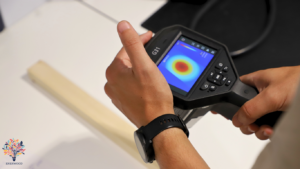
Finally, due to its technical and economic feasibility, the best option was the use of a thermographic camera, which allows heat to be applied and the decrease in temperature derided by the wood in this process to be measured. Therefore, the lower the temperature, the lower the heat and humidity. This method has allowed us to classify the wood into batches according to their degree of humidity and, in turn, optimize the time and heat applied during drying.
All these advances have been commented on in an online conference at the beginning of this month, where the different partners have presented the research carried out and have agreed that ENERWOOD reduces the energy consumption of the wood production process, promotes the use of renewables and optimises processes, thus also reducing the carbon footprint and positioning the sector at the forefront of sustainability and innovation.
The ENERWOOD project is funded by the ‘Ministerio de Industria y Turismo’, through the call for ‘Agrupaciones Empresariales Innovadores 2024’, within the framework of the Plan de Recuperación, Transformación y Resiliencia.