


At CETIM, we apply photocatalysis for the production of green hydrogen from waste streams
BIOPHOTO enables the generation of energy in an efficient, sustainable and economically viable way, while simultaneously valorising residual streams from different industries, transforming an environmental challenge into a high-value resource within a circular economy model.

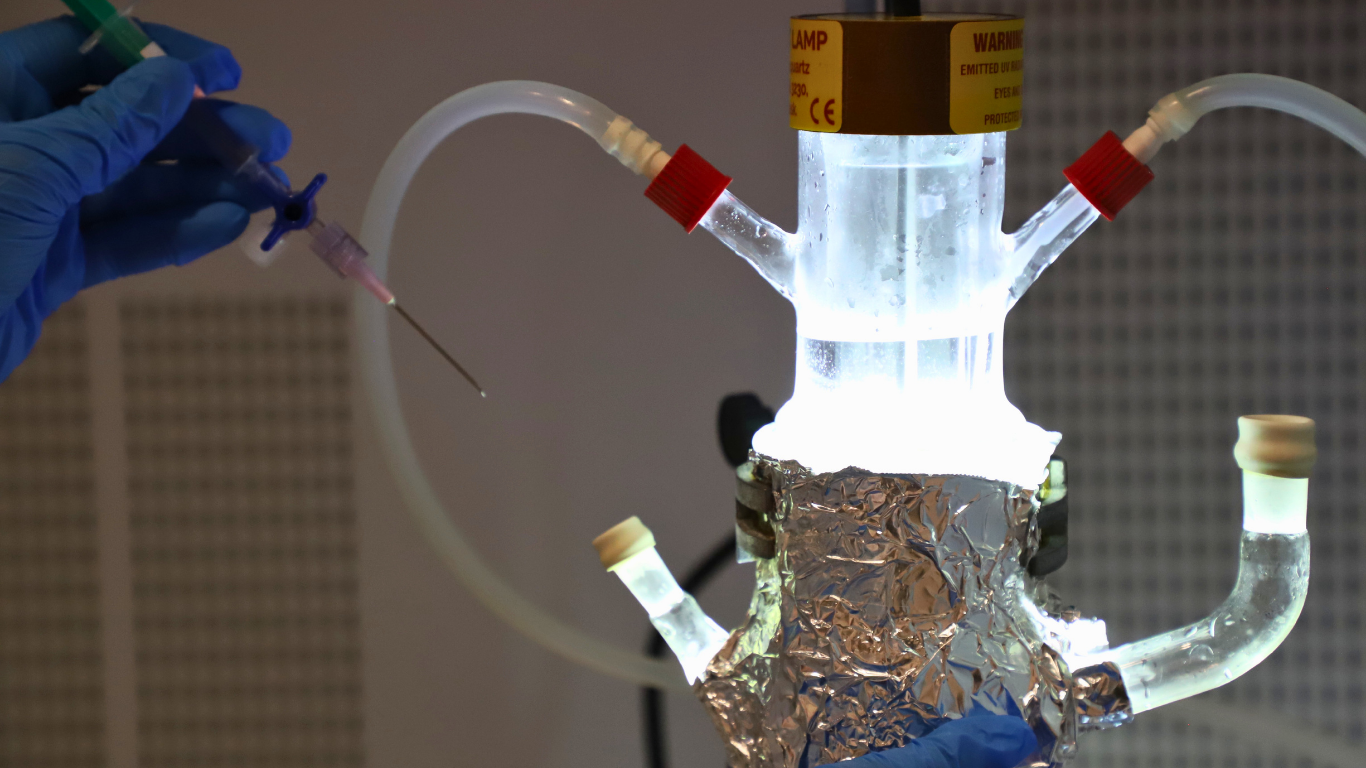
Photocatalysis process at CETIM’s laboratory.
Spain consumes approximately 500,000 tonnes of hydrogen each year as an industrial feedstock across a range of sectors. Most of this hydrogen is currently produced through natural gas reforming, a process that generates CO₂ emissions due to the use of fossil fuels. As a result, green or renewable hydrogen is emerging as a key solution for replacing fossil fuels in sectors that are particularly difficult to decarbonise, contributing significantly to climate change mitigation efforts.
BIOPHOTO has now reached its conclusion, demonstrating that the production, storage and purification of green hydrogen from organic waste streams is already achievable. Moreover, the project not only enables the generation of renewable energy but also promotes the valorisation of waste streams from different industries, transforming an environmental challenge into a high-value resource within a circular economy model.
A sustainable alternative for green hydrogen production
The transition towards a decarbonised economy requires the development of new ways to produce clean and sustainable energy. In this context, green hydrogen has become one of the energy carriers with the greatest potential to reduce CO₂ emissions in sectors that are difficult to electrify, such as industry and transport. BIOPHOTO offers an alternative route for producing green hydrogen efficiently, sustainably and economically.
At CETIM, we developed a chemical process based on photocatalysis that enabled the removal of pollutants from water and air while simultaneously producing hydrogen. Based on the best laboratory-scale results obtained, a maximum potential production of up to 2.5 litres of hydrogen per day could be estimated using the dark fermentation effluent generated by the project coordinator, Cetaqua – Water Technology Centre.
In addition, at our Technological Centre we investigated advanced hydrogen storage strategies, successfully developing several porous materials based on both biomass-derived cellulose carbons and polyHIPEs. These innovative materials achieved hydrogen adsorption–desorption performance comparable to that of commercial materials, positioning them as promising candidates for a range of future applications.
BIOPHOTO, funded through the European Union’s NextGenerationEU programme and coordinated by Cetaqua, with the participation of CETIM, Veolia and Orchestra Sci., has contributed to making hydrogen production more efficient and sustainable. In this way, the project is closely aligned with national and European objectives aimed at achieving climate neutrality by 2050 (Net Zero Emissions 2050), supporting both the energy and ecological transition.
The views and opinions expressed are solely those of the author(s) and do not necessarily reflect those of the European Union or the European Commission. Neither the European Union nor the European Commission can be held responsible for them.
