


In SAHARA, we investigate sustainable solutions for the production of green hydrogen throughout Europe
CETIM will contribute our experience in Life Cycle Analysis, Cost Analysis and Social Life Cycle Analysis to carry out the environmental assessment of the new technology that will be developed in the project to transform solar energy directly into high-purity hydrogen through a photoelectrochemical module with internal water circulation.
The European Green Deal is a set of initiatives promoted by the European Commission to address the consequences of climate change and environmental degradation. Among these measures, the production of renewable hydrogen is a key component for the energy transition and sustainable development.
That is why, in the SAHARA project, we are pushing the boundaries of photoelectrochemical (PEC) technology to unlock a cleaner and more sustainable future for green hydrogen production, contributing to the objectives set out in the European Green Deal. Our goal is to elevate PEC technology to new levels of efficiency, scalability and economic viability, transforming solar energy directly into high-purity hydrogen through a PEC module with integrated water flow.
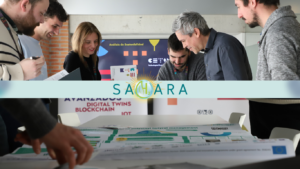
In order to develop innovative and sustainable methods for hydrogen production using solar energy and water, the project has a consortium led by HyCentA Research GmbH and composed of CETIM Technological Centre, Fraunhofer Gesellschaft, University of South Denmark and Redeem Solar Technologies. The entire consortium met at the beginning of the year at the coordinator’s facilities in Graz (Austria), to establish the first steps we are taking in the initiative, which will last 36 months.
Sustainability Analysis, the key tool at SAHARA
A key advance for SAHARA will be to reduce the carbon footprint compared to conventional hydrogen production by reforming natural gas. For this reason, CETIM will contribute its expertise in Life Cycle Analysis, Cost Analysis and Social Life Cycle Analysis by carrying out the environmental assessment of the new technology.
Specifically, at CETIM we are carrying out Life Cycle Assessment (LCA), Cost Cycle Analysis (CCA) and Social Life Cycle Analysis (LCA-S) to analyse the sustainability of hydrogen production. With the LCA we will measure the environmental impacts, such as energy consumption and carbon footprint, thanks to the ACC we will know the economic viability from production to the end of life and the LCA-S will allow us to analyse the social impacts. Our Technology Centre will collaborate with project partners to integrate all these methodologies, ensuring a balance between sustainability, profitability and environmental performance.
In this way, SAHARA is based on three principles:
- Innovative research: We will conduct cutting-edge research to improve hydrogen production technologies.
- Sustainability: We will focus on developing environmentally friendly methods to produce hydrogen.
- Collaboration: We will foster partnerships across Europe to accelerate the uptake of renewable energy solutions.
Through the integration of advanced technologies and research, the project seeks to reduce the carbon footprint of hydrogen production compared to conventional methods, aligning with the objectives of the European Green Deal and moving towards a competitive and climate-neutral economy by 2050 across Europe.
SAHARA is a CETP-FP-2023-00055 project funded by the Ministerio de Ciencia, Innovación y Universidades /Agencia Estatal de Investigación /10.13039/501100011033 and co-funded by the European Union.
