


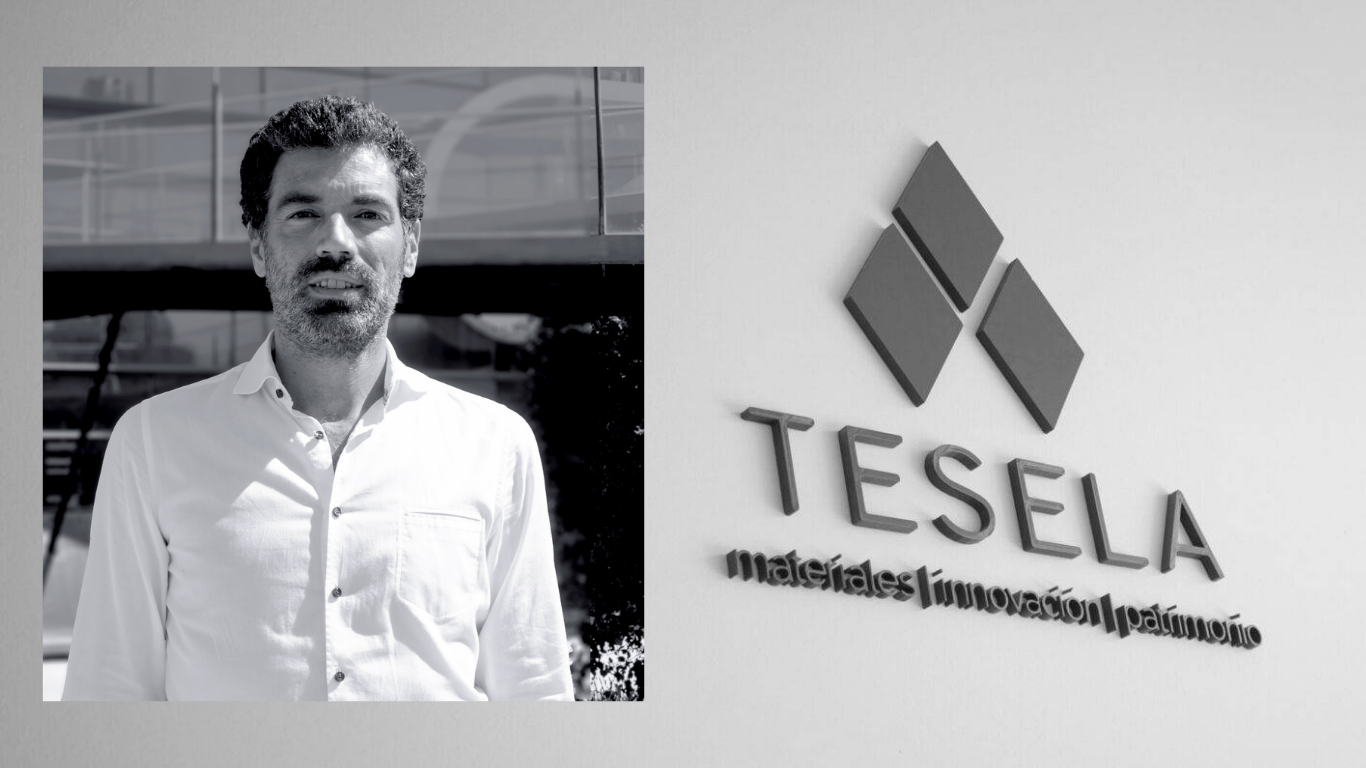
Eugenio Navarro: “Advances in materials science allow us, and at the same time compel us, to think in terms of continuous improvement without getting bogged down in terminology or literal interpretations. Performance is what counts”
The search for innovative solutions requires the support of strong partnerships. An example of this is the partnership between CETIM and Tesela, a technology-based research company specializing in materials, with which we are currently working on the European HERIT4AGES project and the MORFEO Public-Private Partnership project. Today we talk to Eugenio Navarro, Founder and CEO of Tesela, to learn a little more about the company’s mission, vision, and values, as well as the status of both R&D initiatives.
Eugenio Navarro, Founder and CEO of Tesela.
- Tesela was founded as a spin-off from the University of Granada and has been linked to research in materials and heritage since its inception. What needs did you identify in this market?
I always say that TESELA was born by chance and out of love for art (or science, in this case). There was no pressure from anyone, no business group or investor betting on the idea, nor did anyone seek it out. TESELA was born as a subterfuge to do the things we liked best and that our working lives at the time did not allow us to develop. But there was also a market need, obviously.
On the one hand, Eduardo Sebastián, professor in the Department of Mineralogy and Petrology at the University of Granada and co-founder of TESELA, in addition to his teaching and research work, had been doing more and more consulting, analysis, and characterization work for companies and institutions outside academia. On the other hand, my experience was based in private industry, and I was already in demand for product development consulting services from numerous clients linked to manufacturing. It was Anna Arizzi, then a doctoral student in the department and now a professor at the University of Granada and coordinator of the Master’s Degree in Heritage Science and Technology (CiTPA), who, demonstrating her courage and vision, proposed combining these two needs related to materials (ancient and modern) and founding TESELA to organize, improve, and professionalize all the work that, in a way, we had already begun on our own.
- What role do advanced or functional materials play in the preservation of historical assets?
There is a fallacy that has taken root not only among the general public, but also in higher strata, which bases its discourse on the assertion that historical heritage should only be restored and preserved using raw materials and materials that are in some way aged, ancient mortars or almost prehistoric binders, when all this reactionary attitude reveals is a clear lack of ideas for innovation.
In heritage, there is a premise that is often misinterpreted, which already appeared in the famous Krakow Charter, which states that: “historical assets must be restored with materials as similar as possible to the originals.” Fine, but we are in the 21st century and, in addition to being obliged to work with contemporary raw materials and materials, we must understand the phrase from a performance point of view and not literally; that is, what is important is not the materials or their name, but the performance with which they will work on the asset. It is always better to emphasize performance over words, terms, and immobility. Advances in materials science allow and, at the same time, compel us to think in terms of continuous improvement without dwelling on terminology or literalness. Performance is what counts.
- In this vein, you collaborate with CETIM on projects such as HERIT4AGES. How do you assess the work and results achieved by Horizon Europe?
In my opinion, the issue of climate change and energy efficiency in old heritage buildings has historically been a challenge that has been largely ignored in Europe. It has always been viewed as a side issue, and now it is time to rectify this mistake by shifting the budgetary balance towards cultural heritage. That is why we believe this project is of paramount importance, as it offers a package of real, tangible, and measurable solutions to the problems posed by these buildings located in the historic centers of our cities, which cannot be ignored and which, in addition to being maintained and preserved, must also serve a purpose.
In this sense, we feel privileged to be able to work with more than ten participating entities from different regions of Europe, contributing our grain of sand to the consortium, and also to do so in work packages so closely related to our work on the characterization and definition of raw materials and materials. Furthermore, we are doing so alongside CETIM, the leader of these same work packages, with whom we feel comfortable and confident in acting as if we were one. This good working environment is reflected, as it could not be otherwise, in the results, many of which are already being successfully installed in the demo sites planned in the project, well before the end of the project’s execution time. We couldn’t be happier.
- We also collaborate on the MORFEO project, which you lead from Tesela. What impact do you think it has on the construction sector?
Within materials science, alkaline activation is one of the great resources for mitigating CO2 emissions and contributing to decarbonization. If, in addition, we are talking about activating not a product, but a by-product such as electric arc slag, we are faced with the challenge of achieving a level of sustainability never before achieved in the construction sector, since currently most steel slag is disposed of and only a small part is recycled. Blast furnaces are being replaced by electric arc furnaces, which are more advanced and efficient. However, the slag generated is also different in many ways (including its composition), which means that its potential as a precursor for use in alkaline activation must be evaluated from scratch.
The environmental targets that the European Union is imposing on industrial manufacturing chains are increasingly demanding, and the timeframes for meeting them are tight. MORFEO therefore presents itself as an excellent tool for improving people’s lives and promoting social development based on sustainability and the circular economy, the fight against climate change, improvement of the habitat and housing, economic growth, and employment.
- In addition to those mentioned, you have been collaborating with CETIM for many years on various projects (Calsilam, Lim3print, Assemblend, etc.). What value does collaborating with a technology center like CETIM bring to you?
At TESELA, we have always defined ourselves as an eminently collaborative entity in every sense. We are always willing to establish synergies with academia (where we come from) and, of course, with companies (our main clients). But also with technology centers, which, far from seeing them as competition, we view as an opportunity for collaboration and real learning in every sense.
This, which seems so obvious, sometimes fails to materialize for various reasons, all related to the fear of sharing and the inability to work together; with CETIM, this has never been the case. From my first contact with Alberto Miguéns (Lead Researcher of Sustainable Building Materials, Advanced Materials Area), a great rapport was established between us on a professional and personal level with the entire CETIM team, not only technical but also administrative and executive, which in some way lubricated and launched a series of ideas and projects that sometimes originated from CETIM and sometimes from TESELA, but regardless of that, they have been undertaken jointly. Proof of this is the long history of successful collaboration that has been achieved between the companies in just a few years. This is the best example to defend the idea that alliances always add value. Reaching the top of the mountain together is always more satisfying and enriching than doing it alone..
- How does the circular economy influence your business?
Both the circular economy and sustainability are two basic and non-negotiable pillars of our activity, which also cut across our entire line of business, forming part not only of our company’s mission, vision, and values, but also of its purpose and statutes.
At TESELA, we have the capacity to work from very low TRLs to technologies that are very close to market. In both cases, the circular economy conditions a large part of the tasks and activities of each project, always aligning the project with circularity. But even more so when we have the opportunity to bring a developed solution to the streets, to the people, for which we can measure and quantify the Life Cycle Analysis or Cost Cycle Analysis, defending the progress in circularity achieved throughout the project. We must be able to keep products and materials in use for as long as possible in order to contribute effectively to the transition to a real circular economy.
- What trends will shape the future of materials used in heritage conservation?
At the rate things are changing today, it is very difficult to know what new materials will be used to protect our heritage in the future. What is cutting edge today is obsolete tomorrow, and state-of-the-art technologies are becoming so ephemeral that they are almost impossible to keep track of.
If we look back today and review the criteria and choice of materials used by professionals of previous generations to undertake certain interventions on cultural property in the 1960s, for example, we might be horrified. But we must remember that at that time, the best solution was chosen based on the tools and knowledge available at the time. Therefore, perhaps in 50 years’ time, someone will rub their eyes in disbelief when reviewing today’s criteria and decisions. We must see this as something natural, part of progress, although I do not believe that the general trend in heritage conservation will change much with regard to these four premises. We need to develop new materials that:
- Do not cause further deterioration to old materials
- Develop the appropriate performance to provide a solution to the damage and pathologies that time has caused to these assets
- Ensure maximum durability of the intervention
- Are capable of capturing the cultural heritage values of the original work
|
IN DETAIL TESELA is a technology-based research company specializing in both ancient and innovative materials. Located in Granada, since 2015 it has focused its main activity on the analysis, characterization, and development of solutions mainly for architectural heritage, although it also creates solutions for energy efficiency, the use of industrial waste and by-products, and the recovery of raw materials and other natural resources. Today, they position themselves as agents of transformation for companies and society, helping them adapt to the challenges of a constantly evolving sector. |