At CETIM, together with Grupo Puentes, we are developing a remote infrastructure monitoring system using optical fibre
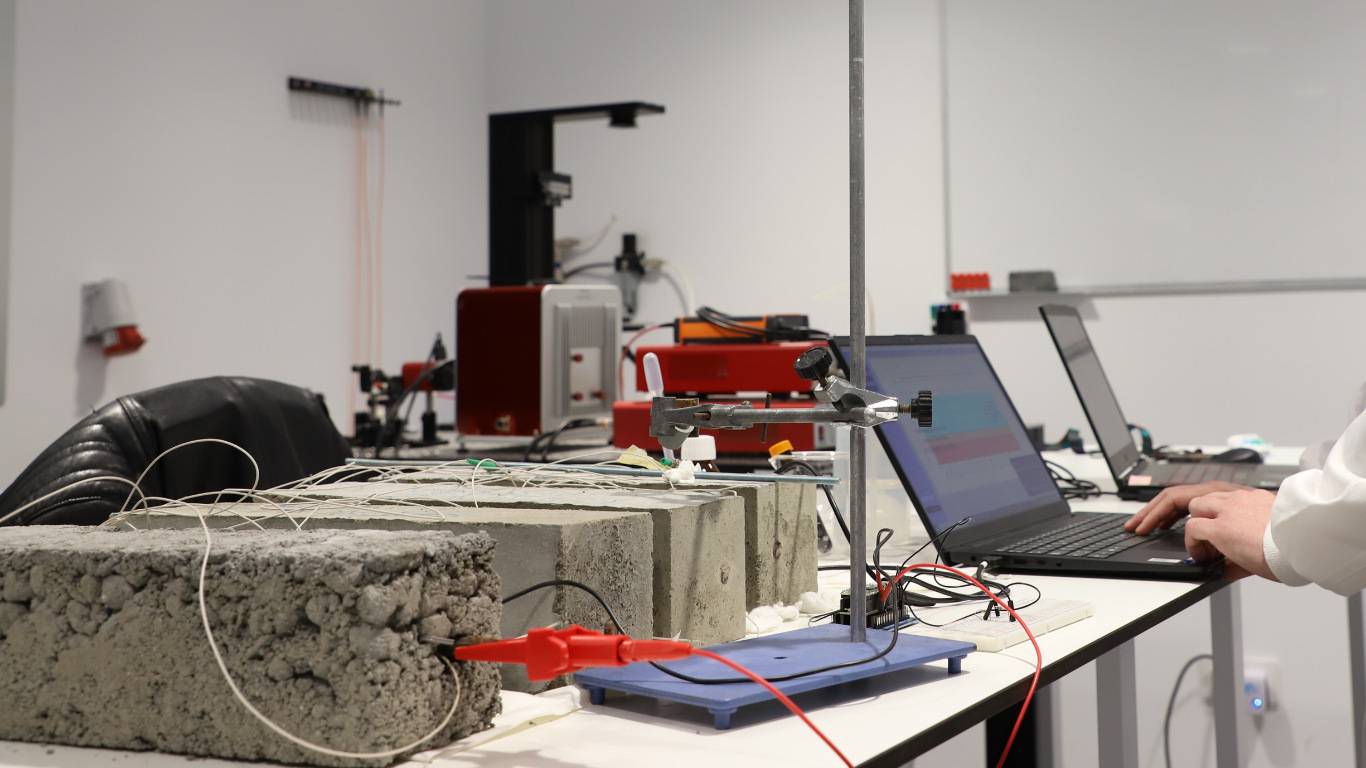
For the FIBERSENS project, we use Fibre Bragg Grating networks embedded in concrete to obtain information on four parameters that are critical to the conservation of large infrastructure (corrosion, humidity, temperature and internal strain).
Testing for the FIBERSENS project in CETIM’s Digital Industry laboratory.
The safety and durability of large infrastructure depend, to a great extent, on the ability to know its condition and detect potential damage before it becomes a more serious problem. Traditionally, this work relies mainly on periodic visual inspections carried out by specialist personnel, who assess possible damage or signs of deterioration. However, as these are spot checks, it can be difficult to detect incidents in time and optimise maintenance tasks.
Against this background, at CETIM Technological Centre, together with Grupo Puentes, we have developed a solution based on optical fibre sensors embedded in concrete that makes it possible to monitor the condition of infrastructure remotely and continuously. This technology makes it easier to obtain relevant information to plan maintenance more efficiently, reduce site visits and help improve the safety and service life of structures.
The system can record and analyse data relating to four parameters that are critical to the conservation of infrastructure: corrosion, humidity, temperature and internal strain. Monitoring these variables over time provides information on how structural conditions are evolving and helps to identify possible anomalies, moving towards a more predictive, data-driven maintenance model.
What if infrastructure could ‘feel’ and anticipate its own condition?
In 2022, CETIM and Grupo Puentes launched the transition towards smart, resilient and connected infrastructure with the Fibersens project. The main objective has been to develop new smart structures for civil engineering based on the integration of optical fibre sensors in concrete, enabling long-term monitoring of the health of structures, increasing their safety and service life while improving cost control.
To achieve this, we needed good resolution, robustness and reliability in extreme conditions. We therefore used Fibre Bragg Grating networks, which were embedded in the structure to obtain vital information for infrastructure maintenance remotely and continuously. They also offer the advantage of allowing measurements over long distances without interference, compared with the monitoring systems used until now. In addition, we have developed our own data acquisition system operated from a central control point, which avoids the need for technicians to travel to site and has a positive impact on costs and occupational safety.
From spot inspections to predictive maintenance
Fibersens has shown excellent performance in the tests carried out, both in the laboratory, where different configurations for integrating sensors into concrete have been tested, and in a real-world setting. The results showed high stability and accuracy of the sensors, which proved highly resistant and reliable under extreme environmental conditions, maintaining predictable behaviour even after prolonged periods of exposure and with loads of up to 20 tonnes.
In this way, FIBERSENS represents a paradigm shift: from spot inspections to continuous, remote, data-driven predictive maintenance. The result is greater safety, lower costs and optimised management of large infrastructure.
Fibersens was funded by the Ministerio de Ciencia e Innovación through the Agencia Estatal de Investigación under the 2021 call of the Public-Private Collaboration Projects Programme of the State Plan for Scientific, Technical and Innovation Research 2021–2023. The aid was financed by the European Union through NextGenerationEU funds under the Recovery, Transformation and Resilience Plan.