


LIFE smallWAT: Creation of modular and technologically advanced bioelectrochemical wetlands adapted to population and climate scales
CETIM is participating in the LIFE smallWAT project to develop and demonstrate an innovative, modular, versatile and resilient wastewater treatment system for small agglomerations (<2,000 PE) in different climatic conditions, adaptable to local contexts and needs.
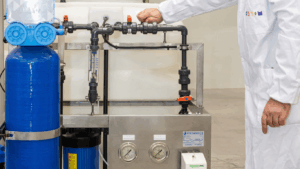
Technology similar to that to be developed in LIFE smallWAT.
Access to sustainable, efficient and low-cost wastewater treatment systems remains a challenge for many small rural and peri-urban populations. These communities often face economic, technical and spatial constraints that hinder the implementation of water treatment technologies.
LIFE smallWAT project, in which CETIM is participating, proposes the development of modular and technologically advanced bioelectrochemical wetlands, designed to easily adapt to different population scales and environmental conditions. The aim of the project is to develop and demonstrate an innovative, modular, versatile and resistant wastewater treatment system for small agglomerations (<2,000 PE) in different climatic conditions, adaptable to the local context and needs.
In this initiative, led by FCC Aqualia, we will work with partners from France, Spain and Denmark for 48 months to achieve high nutrient removal for direct discharge of treated wastewater, produce water for reuse and nutrient recovery for the fertiliser industry, and recover water with nutrients for direct reuse in agricultural irrigation. To this end, the solution will consist of a combination of constructed wetland , natural filtration units for nutrient recovery and UVC-LED for disinfection, which can operate as separate units or as a complete system.
To achieve the project’s objectives, the LIFE smallWAT methodology covers four interdisciplinary blocks:
- Design of LIFE smallWAT solutions for each site based on the background of each technology and the local context.
- Validation of each site and analysis of results to define replication sites and develop guidelines for future replication and expansion.
- Development of a multi-criteria decision framework for the selection of wastewater treatment technologies, considering environmental, economic and social aspects.
- Maximising the sustainability, replicability, scalability and exploitation of the project’s results and impacts.
CETIM expertise
CETIM is part of the consortium, together with AQUALIA (Coordinator), AQUALIA France (AE), CETIM, ECOBIRD, COTRAM (AE), AARHUS UNIVERSITET, HEROGRA FERTILIZANTES, HERMIGUA TOWN COUNCIL, LA GOMERA ISLAND WATER COUNCIL.
At our Technology Centre, we will be responsible for the construction of biochar filters and the design and development of a disinfection system using UV-LED technology. In addition, we will participate in the validation and comparative evaluation of these developed technologies and in the monitoring of their energy efficiency and water quality in the different pilot projects. Furthermore, CETIM will carry out a life cycle assessment (LCA) to evaluate the environmental impact and will participate in the phytoremediation research activities of Aarhus University.
LIFE smallWAT is aligned with water priorities, specifically Water Services, through the demonstration and implementation of innovative wastewater treatment solutions aimed at improving the provision of resource-efficient wastewater treatment services for the population of small localities. The project also aims to increase water quality by reducing nutrient and organic pollution discharges into water bodies in the European Union. LIFE smallWAT will therefore improve the efficient management of water resources, preserving water quality and preventing the misuse and deterioration of scarce water resources.
LIFE24-ENV-ES-LIFE smallWAT | Project code: 101215667
