NanomatIA: Nanomaterials, biotechnology, and Artificial Intelligence for more efficient and sustainable batteries
CETIM is the scientific coordinator of the project, in which we will investigate different mechanical, chemical, and biotechnological technologies for the search and treatment of lignin- and cellulose-based nanomaterials that can be applied to various elements of electrochemical cells to improve their functional, environmental, and economic properties.
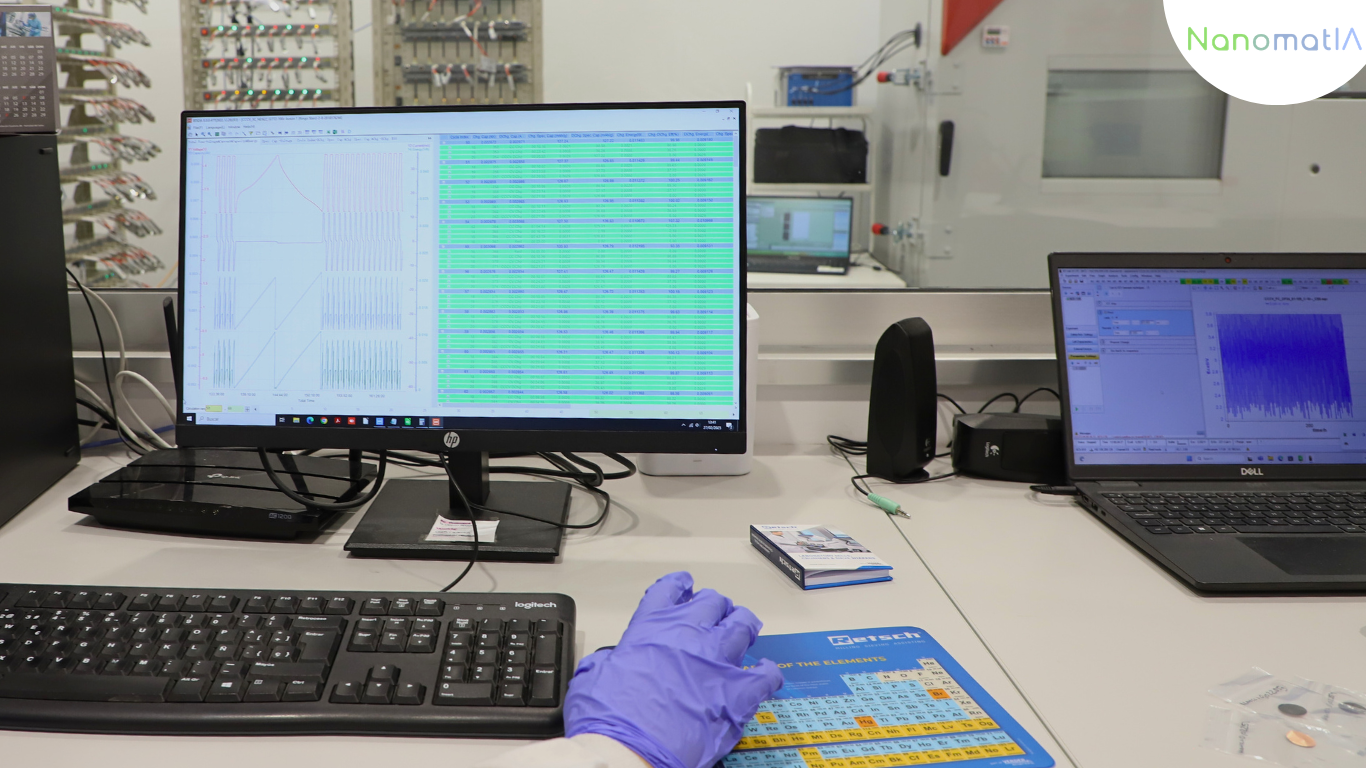
Energy Storage Materials Laboratory at CETIM.
With the growth in demand for electric vehicles and the decarbonization and sustainability targets set by Europe, the discovery of new high-performance materials for the energy storage sector is now an unavoidable challenge. Therefore, nanotechnology and biotechnology are two strategic fields that can bring great advantages in the search for new materials. If we add to this the action of new technologies, such as Artificial Intelligence, we will be able to discover and optimize new materials, interfaces, and cells more quickly.
This is the premise behind the NanomatIA project, in which we are researching and developing new nanomaterials driven by Artificial Intelligence and industrial biotechnology. The goal: to build a specific architecture of AI agents to automatically discover and predict new advanced materials for new configurations in electrochemical recipes for the main components of a cell (anode, cathode, and electrolyte). The protagonists of this initiative are nanomaterials obtained through conventional and biotechnological processes, due to their unique properties, which will enable the creation of cells with advanced, sustainable functionalities and a lower economic impact.
NanomatIA: Key Points
The key and innovative aspect of NanomatIA is that it brings together three disciplines:
1) Development of new advanced materials such as micro- and nano-silicon, carbon nanofibers, micro- and nano-cellulose and lignin, nanostructured metal oxides, and electrolytes obtained using nanotechnology. All of these improve the sustainability of manufacturing and modification processes, as well as obtaining better electrochemical responses in their applications.
2) The application of biotechnology to obtain and modify micro- and nano-cellulose and lignin. This allows us to achieve more sustainable and toxin-free processes, improve enzymatic specificity, and maximize process efficiency.
3) Creation of a reinforcement learning framework, integrating various techniques to create AI agents capable of automatically discovering and predicting new advanced materials for new configurations in electrochemical recipes.
NanomatIA: The entities behind the initiative
The entities in the group cover the entire value chain for the R&D of new nanomaterials, driven by artificial intelligence and industrial biotechnology, and their application for energy storage.
At CETIM, we are the scientific coordinators of the initiative and responsible for different mechanical, chemical, and biotechnological technologies for the search and treatment of nanomaterials, based on lignin and cellulose, which we will apply in various elements of electrochemical cells. In turn, we are carrying out electrochemical testing of the materials optimized throughout the project.
Over the last year, our Technological Centre has made progress in strategies for obtaining cellulose nanoparticles, with particular emphasis on biotechnological processes through the design and evaluation of oligonucleotides to identify lignocellulosic enzymes for their production. Similarly, thanks to chemical processes, we have achieved high rates of reuse of reaction media, thus increasing sustainability, with excellent properties in terms of particle size and stability. At the same time, we have added value to lignin by developing micro- and nanoparticles, through the comparison of various mechanical techniques and chemical methods, increasing control over size and morphology. With these technological processes, we are opening up new functional possibilities for these materials and their incorporation into electrochemical systems together with the other materials of the NanomatIA consortium, which includes:
- Leitat participates in the development of metal oxide nanostructures and polymeric nanofibers, and in the electrochemical formulations of silicon-based anodic slurries, cathodic slurries, and electrolytes.
- Lurederra focuses on the development of metal oxide nanostructures and electrochemical recipes for anodic slurries and cathodic slurries.
- The University of A Coruña, through the EXPRELA research group, participates in the development of custom enzymes for processes to obtain micro and nano fibers from cellulose and lignin.
The business group is led by HI Iberia, a company specializing in the development of software solutions, which is creating an effective modular architecture for NanomatIA for the reverse design of nanoparticles based on AI, as well as its validation. The group is completed by:
- Ferroglobe, a company with important discoveries in new silicon purification processes, is responsible for producing micro and nano silicon for the project, as well as developing anodic slurries based on this material.
- Rimsa, an innovative SME specializing in the development of raw materials and materials with high added value. It participates in NanomatIA through the creation of metal oxide nanostructures in the electrochemical recipes for anodic and cathodic slurries, respectively.
- ENSO, a technology-based company whose activity revolves around the R&D of new processes, technologies, products, and services that reduce its environmental impact. Its activity in the project focuses on the development of electrolytes.
In the coming months, CETIM will continue working on NanomatIA through research into enzyme-based biotechnological processes for obtaining nanocellulose, studying the stability and drying of lignin nanoparticles, and further developing chemical modification strategies in line with the specific needs of end applications. Similarly, we will continue with the electrochemical evaluation of different materials in synergy with the entire consortium to achieve the project’s objectives.
NanomatIA: New nanomaterials driven by artificial intelligence and industrial biotechnology (PLEC2023-010301) has been funded by the Ministerio de Ciencia, Innovación y Universidades and the Agencia Estatal de Investigación (MCIU/AEI/10.13039/501100011033) and is part of a coordinated action within the framework of the Transmisiones initiative, with the group of companies receiving funding from the Centro para el Desarrollo Tecnológico Industrial (CDTI).