At CETIM, we are accelerating the transformation of the textile industry towards more circular, efficient and competitive models
We bring our technological capabilities to STITCH, ATENEA and TRUSTEX, three research projects in which we are developing advanced recycling solutions, sustainable materials and digital traceability in the textile sector, exploring new ways of recovering materials and encouraging their reintegration into production processes.
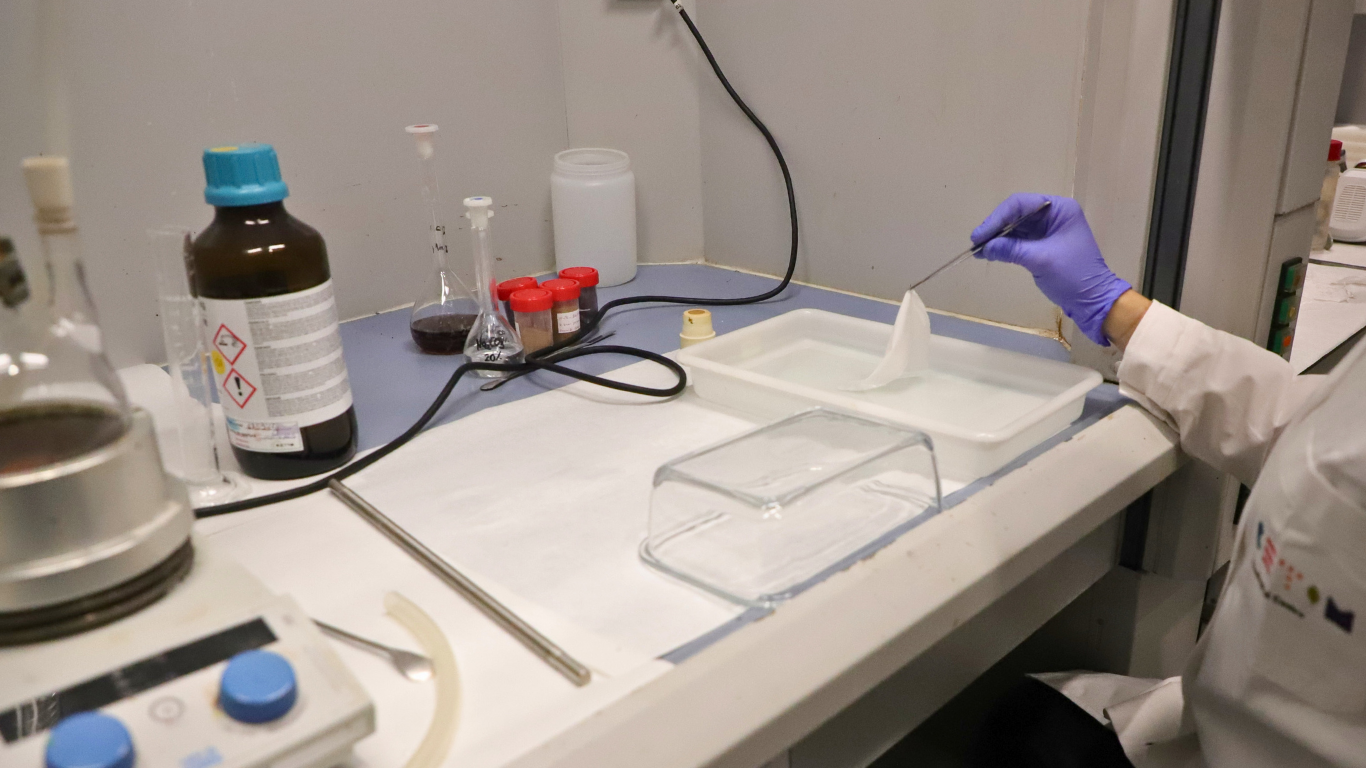
Textile recycling trial at CETIM
Global textile fibre production reached 132 million tonnes in 2024, according to Textile Exchange’s Materials Market Report 2025. The same report notes that less than 1% of fibres produced worldwide came from the recycling of textile waste. These figures highlight the need to move towards a more sustainable textile industry, seeking solutions that make it possible to valorise waste, reintroduce recycled raw materials into production processes, improve traceability and reduce the environmental impact of products.
At CETIM, we put our technological capabilities at the service of this transformation, addressing different stages of the value chain. We research physical, chemical and biological recycling processes for complex textile waste and develop new polymer formulations, biopolymers and renewable-origin materials. We also work on valorising lignocellulosic resources and transforming them using technologies such as extrusion, compounding and injection moulding to obtain high-added-value materials and products.
These capabilities are complemented by digital technologies for the identification, sorting and traceability of materials, using computer vision, photonics, the Internet of Things (IoT) and sensor systems. We also apply sustainability assessment tools, such as Life Cycle Assessment, to study environmental impacts and guide the development of more sustainable solutions.
Aware of the sector’s needs in terms of sustainable competitiveness and increasingly demanding regulatory frameworks, CETIM has made a strategic commitment to adapting its well-established technological capabilities and making them available to the sector, together with a significant investment in expanding its services to industry. The Centre has acquired scientific equipment for the characterisation of post-consumer and post-industrial textiles: in addition to the installation of a pyrolysis-gas chromatography-mass spectrometry (Py-GC/MS) system for detecting contaminants present in small proportions, there are techniques such as Differential Scanning Calorimetry (DSC), thermogravimetric analysis (TGA), Fourier-transform infrared spectroscopy with attenuated total reflectance (FTIR-ATR), gas chromatography-mass spectrometry (GC-MS), high-performance liquid chromatography with diode array detection (HPLC-DAD) and inductively coupled plasma mass spectrometry (ICP-MS), with which the Technological Centre offers a comprehensive range of textile characterisation services.
STITCH: Advanced recycling and new materials from complex textile waste
In the STITCH project, we are researching and developing technological routes to valorise multi-composition textile waste, especially waste that is hardest to recycle. As part of a consortium led by Sogapol and made up of CETIM and Tattoo, we work with waste from both separate collection and municipal solid waste, with the aim of improving its use and creating new application opportunities, both within the textile sector itself and in other industries with potential for short- and medium-term transfer.
In the project, CETIM leads two key lines of work. The first focuses on the recycling and advanced purification of multi-composition textile waste, researching mechanical, thermomechanical and chemical processes to recover high-quality raw materials. The second addresses the synthesis and formulation of new polymeric and hybrid materials from the recovered resources.
These developments are geared towards three valorisation routes: panels for the construction sector, pellets and resins for chemical-polymer applications, and pellets of suitable quality for conversion into new textile fibres. In this way, STITCH seeks to close the materials loop and diversify their applications, linking advanced recycling with new industrial opportunities.
ATENEA: Sustainable and circular technologies to valorise textile waste
The ATENEA project aims to develop a comprehensive valorisation system that will improve the management of textile waste, from its identification and sorting to its transformation into new resources for a range of industrial applications. As part of a consortium led by ENCE, of which CETIM is a member, we are researching solutions to boost the circularity and sustainability of the entire textile waste value chain in Spain.
Specifically, CETIM is taking part in the characterisation of different textile waste streams and in developing solutions to valorise the recovered materials. At our Technological Centre, we are valorising the polyester fraction, researching strategies for effluent treatment and making use of the PET and regenerated cellulose fractions obtained from chemical recycling. These activities will help to broaden the possibilities for resource recovery and facilitate their reintegration into new production processes.
In addition, ATENEA addresses the mapping and traceability of textile waste, as well as the digitalisation of separation processes using automated technologies. These actions will make it possible to obtain more homogeneous fractions of materials that are better suited to mechanical and chemical recycling through efficient and sustainable processes. The recovered materials will then be valorised for use in strategic sectors such as textile, automotive, water treatment, plastics and construction, through closed-loop and open-loop circularity strategies.
TRUSTEX: Digitalisation and traceability for a circular textile value chain
In TRUSTEX, we are driving the transition towards a more circular textile industry across Europe through innovative strategies in eco-design, traceability, the collection and sorting of textiles, reuse and recycling. The project is aligned with European Extended Producer Responsibility schemes, with the aim of contributing to their effective implementation by identifying weaknesses, optimising existing systems and incorporating digital solutions.
In this Horizon Europe project, CETIM plays three key roles: digitalisation of the textile value chain, optimisation of circular strategies and sustainability assessment. In the area of digitalisation, we are leading the development of a blockchain-based platform for the Digital Product Passport, designed to guarantee the traceability of textiles throughout their life cycle. We are also collaborating on the integration of interoperability and digital labelling solutions, using QR codes and radio frequency identification, which facilitate the identification and management of products.
In terms of circularity, we carry out laboratory-scale recycling trials on cotton textiles and polyester-cotton blends, with the aim of maximising the recovery of cellulose and polyester, as well as optimising the environmental impact of the processes. The work includes chemical recycling routes using hydrothermal treatments and alkaline hydrolysis, as well as the mechanical and chemical recycling of thermoplastic and thermoset polymers, including materials such as epoxy resins, polyurethanes and polyesters. This research makes it possible to explore new ways of recovering materials and to encourage their reintegration into production processes.
Likewise, in TRUSTEX we assess the environmental impact of the solutions developed using Life Cycle Assessment methodologies, which allows us to quantify environmental impacts, compare technological alternatives and guide the development of solutions aligned with the principles of the circular economy and safe ecodesign.
Through applied research and collaboration with companies and other players in the value chain, we continue to drive solutions that connect materials innovation, advanced recycling and digitalisation. The aim is to turn textile waste into new resources, reduce environmental impact and contribute to a more circular, resilient and competitive industry.
STITCH is part of the 2025 call for Public-Private Collaboration Projects, managed by the Agencia Estatal de Investigación (AEI) and the Ministerio de Ciencia, Innovación y Universidades.

ATENEA is funded by CDTI with FEDER funds 2021–2027 through the Regional Consortia Innterconecta STEP aid programme.


TRUSTEX has received funding from the European Union’s Horizon Research and Innovation program under grant agreement N° 101181901 and from the Swiss State Secretariat for Education, Research and Innovation (SERI)