


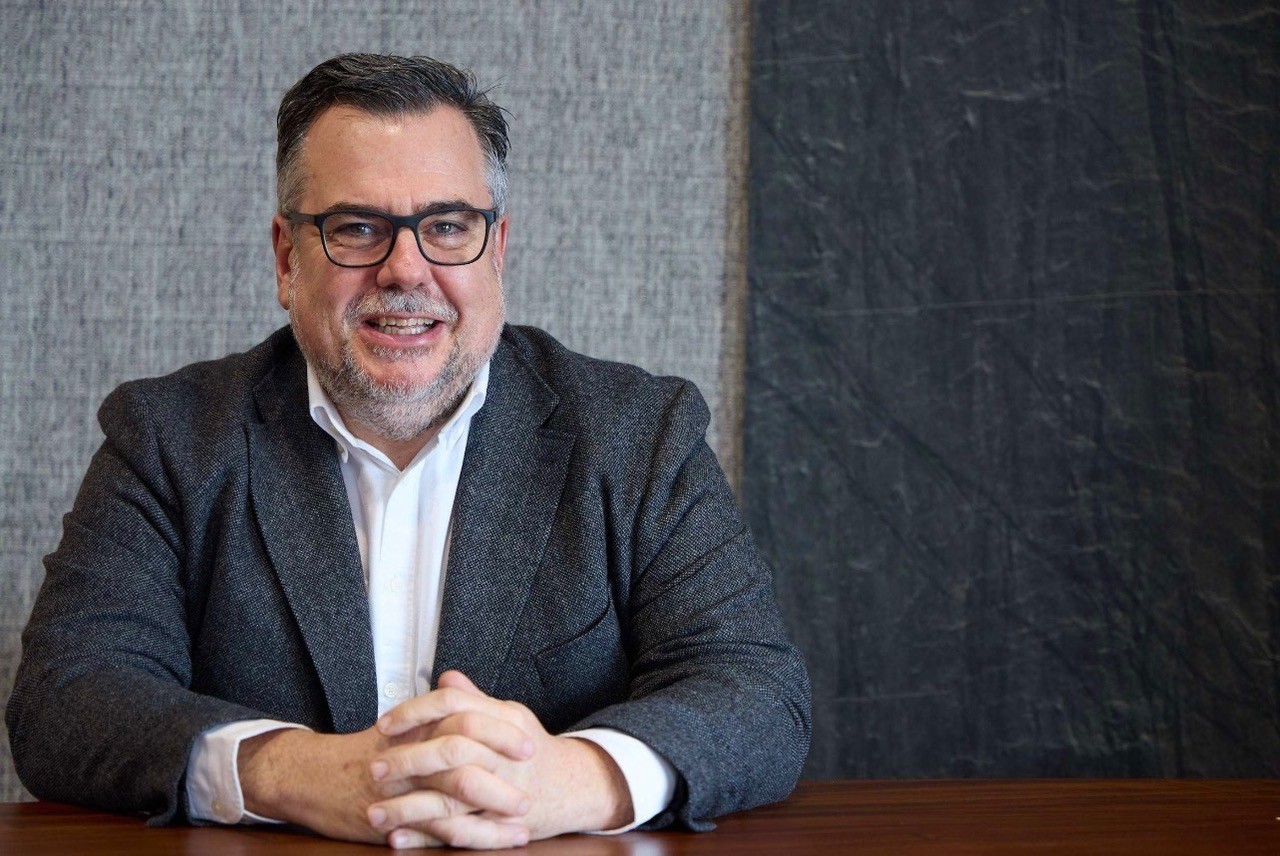
Pablo García-Bodaño: “The true circular economy begins when we stop seeing waste as a problem and start seeing it as a raw material”
The circular economy has become one of the great challenges of our time, as it proposes a new way of understanding production, consumption and resource management. Its true potential goes beyond reducing waste: it is changing the way we look at materials, allowing us to discover new opportunities. With this vision in mind, we spoke about the challenges of sustainability and the need to move towards more efficient and responsible production models with Pablo García-Bodaño, CEO and Founder of Tattoo Contract and WIM Studio, with whom CETIM collaborates on several R&D initiatives to transform textile waste into new high-value products, such as panels for the construction sector.
Pablo García-Bodaño, CEO and Founder of Tattoo Contract and WIM Studio.
- Tattoo Contract was founded in 2010 with the aim of democratising access to the contract sector. What need did you identify that led to the creation of the company, and what were the early days like?
Tattoo came about because we identified a very specific need: the contract world was highly fragmented and, in many cases, accessing quality solutions meant working with many different suppliers, with little capacity for coordination and processes that were not very agile.
Our idea was simple: to make contract more accessible and offer the client a comprehensive solution, from design and manufacturing through to coordination and installation. We started with plenty of resources, but with enormous enthusiasm and the conviction that we could do things differently.
Over time we grew, learning from each project and working for very different sectors: hotels, retail, offices, public spaces, etc.
But if one thing has remained constant from the start, it is an obsession with delivering, solving problems and standing by the client. For me, that is one of the keys that has allowed us to get where we are.
- Twelve years later, you spotted another opportunity and WIM Studio was born. What drove you to develop this new project?
WIM Studio was born from a very simple question: why should waste remain waste?
After many years working on architecture, interior design and fit-out projects, we began to notice huge quantities of materials and by-products that still had great potential.
We decided to go a step further: not just to use existing materials, but to research, develop and manufacture our own materials from waste.
That is how WIM Studio came about, as a natural evolution of our experience at Tattoo, but with a much stronger focus on innovation, research and the circular economy.
For me, WIM also represents a different way of understanding sustainability. It is not just about recycling, but about turning a problem into an industrial and economic opportunity, creating materials that can compete on performance, design and price with conventional materials.
- At WIM Studio you research, develop and manufacture new products from waste. What difficulties do you face in taking an innovative material from the laboratory to a real industrial application?
This is probably one of the hardest parts. Getting a material to work in the laboratory is one thing; getting it to work industrially is something very different.
You have to work on stability, repeatability, strength, finishes, certification, production processes, costs and, above all, on ensuring the material can be manufactured consistently.
You also have to get the market to understand it. A circular material cannot ask the customer to give up design, quality or performance.
That is why at WIM we try to work from the outset with a very industrial vision. We do not want to create materials that stay in a laboratory or end up as a pretty sample. We want them to end up as part of real projects.
This is where collaboration with technology centres and universities is essential: it allows us to turn a good idea into a solution that is technically viable, certifiable and scalable.
- You share with CETIM the mission of promoting circular economy solutions for industry. What does working alongside a technology centre like CETIM bring you?
It brings us something fundamental: the ability to turn a business intuition into technical knowledge and an industrial solution.
We are very close to the market and we know the needs of our customers, of architects and of projects. CETIM brings scientific knowledge, testing and characterisation capabilities, and technological development.
That combination is very powerful.
I believe the future of innovation lies precisely in connecting companies, technology centres, universities and the waste generators themselves. Each one holds a piece of the puzzle.
Our relationship with CETIM allows us to move forward with greater rigour and, above all, to speed up processes that would be very difficult to develop from within a company alone.
We also share a philosophy: the circular economy cannot remain just talk. It has to translate into processes, materials, products and industrial applications capable of generating a real impact.
- One of our ongoing collaborations is KONT, a project to turn textile waste into new high-value products. How do you manage to turn the sector’s needs into a new opportunity?
We normally ask: ‘What do we do with this waste?’ We try to ask: ‘What can we create with it?’
When we analyse textile waste, for example, we don’t see it merely as a management problem. We see a raw material that has already required resources, energy and labour to exist.
The challenge is to find an application in which that material can once again have value.
This is where our experience at Tattoo and our relationship with architects, designers and clients help us a great deal. We know what products the markets need and what performance they must deliver.
That is why we try to work the opposite way to usual: start with the waste, but think from the outset about a real application.
True circularity appears when we manage to close that circle: waste, transformation, new material, product and, finally, a customer willing to use it.
- You are currently working with CETIM on the STITCH project, which is also focused on valorising textile waste. What impact do you think this initiative will have? Do you think the right technology can address the challenges facing textiles and other sectors?
I am convinced it can, although we must be realistic: technology alone is not going to solve the problem. We need technology, industry, investment and a market.
The textile sector generates enormous quantities of waste and there is still huge potential to valorise it. STITCH can help precisely by demonstrating that this waste can become new raw materials and products with real applications.
But the most important impact, for me, will be changing the perception of waste.
We need to stop talking about ‘waste’ and start talking about resources that are in the wrong place.
And this is not exclusive to textiles. The same applies to wood, mollusc shells, certain industrial by-products and many other materials that currently have very low value.
Technology will allow us to recover and transform these resources. The real challenge will be ensuring that the resulting solutions are competitive, scalable and attractive to the market.
- Speaking of challenges, what do you think are the biggest challenges and what measures are you developing at Tattoo and WIM Studio to address them?
The biggest challenge is making sustainability stop being a statement of intent and become a different way of doing industry.
We have to produce better, use resources better, reduce waste and, at the same time, remain competitive.
At Tattoo, we try to do this by incorporating criteria of durability, efficiency, innovation and sustainability into the projects we undertake. And at WIM we have gone a step further: working directly on the source of the problem, researching how to transform waste into new materials and products.
I also believe we have to tackle greenwashing. The market needs transparency and data, not just messages.
That is why our goal is very clear: to create circular solutions that make technical, economic, aesthetic and environmental sense.
In the end, if we get a customer to choose a circular material because it performs better, has an attractive design and also reduces environmental impact, we will have achieved something far more important than making a sustainable product: we will have changed the way things are done.
|
IN DETAIL Tattoo Contract is a Galician company founded in 2010 for the comprehensive management of fit-out and space design projects for hotels, retailers, offices, large commercial premises, residential buildings and public spaces, among others. It covers design, manufacturing, coordination and installation, paying particular attention to quality, durability, innovation and sustainability. From this brand came the project WIM Studio, which specialises in the research, development and manufacture of new materials and solutions for design and architecture from a circular economy perspective. The initiative works with by-products and waste from different industries (such as textile waste, wood or mollusc shells) to transform them into new materials and pieces for real-world applications. |