


The DICKENS project has the collaboration of our Technology Centre and the companies ENCE, MASTERS BUILDERS, QMC, BRUPER, OMAR COATINGS, TECNOCAUCHO and CARINSA to offer environmental and economic solutions to the traditional processes of obtaining polymer composites.
In recent years, numerous studies and reports show that plastic consumption has been increasing in most countries. In addition to this, the values of bioeconomy, circular economy and reduction of environmental impact, as well as the search for bio-based alternatives, have been gaining strength in most companies. Research in thermosetting resins and, especially, in the development of bio-based and eco-sustainable composites is key to responding to the pollution generated by the high consumption of plastics.
This is the origin of the DICKENS project in which CETIM is participating, in collaboration with ENCE, MASTERS BUILDERS, QMC, BRUPER, OMAR COATINGS, TECNOCAUCHO y CARINSA. The main objective of the research is to optimise biocomposites from natural sources, such as lignins and vegetable oils, based on the analysis of each and every one of their key biocomponents (matrices, fillers and additives) in an integral manner. For the correct optimisation and validation of these bioproducts, their implementation in safe and eco-sustainable technologies for the design and development of specific products for the plastic chemical solutions (additive manufacturing, composite parts, coatings, adhesives, etc.) and construction sectors is being taken into account.
CETIM in DICKENS
In our Technology Centre we develop, in our laboratories for DICKENS, biomatrices from vegetable oils and lignins for epoxy, polyurethane and acrylic systems. We are also researching biofillers from lignins and celluloses, as well as the encapsulation of bioadditives to improve the performance of the final products.
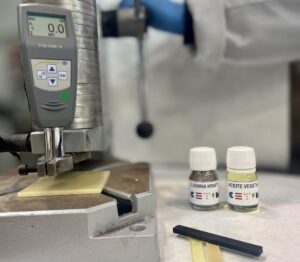
To guarantee the performance of the final products, we investigate each and every one of the biocomponents (matrices, fillers and additives) through different tests, such as the ‘Shore’ hardness test in which we are using a PCE Ibérica durometer.
Thanks to DICKENS, we will develop new alternative biocomposites to conventional polyurethane, epoxy, unsaturated polyester and acrylic resins, incorporating biomatrices, biofillers and bioadditives developed from renewable sources, such as vegetable oils and lignins, in their composition. All this, reducing the environmental impact of traditional processes for obtaining polymer composites, reducing energy costs and improving the properties of the products.