At SUSPENSE, we will develop safe and sustainable bio-based wood adhesives
At CETIM, we are participating in the search for sustainable alternatives to conventional fossil-based compounds used in the wood sector to improve the circularity of sectors such as construction, packaging and real estate, among others.
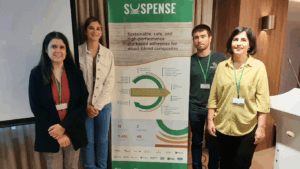
Advanced Materials Team and CETIM European Projects Office at the SUSPENSE Kick Off.
Historically, fossil-based adhesives have been used in sectors such as construction, packaging and the furniture industry, posing environmental and health risks due to their composition of harmful chemicals such as formaldehyde and isocyanate. Furthermore, the use of these types of adhesives complicates the recycling process and exacerbates waste management problems.
The European SUSPENSE project was created to seek sustainable alternatives. It is an innovative initiative within the framework of the Circular Bio-based Europe Joint Undertaking (CBE JU), in which CETIM is participating alongside 14 partners from different countries with the aim of developing and demonstrating innovative, safe and sustainable bio-based adhesives to replace conventional fossil-based adhesives.
A few days ago, the launch meeting for the initiative took place at the CHIMAR HELLAS SA facilities in Greece, where our Advanced Materials and European Projects Office teams travelled to participate in the event, together with all the partners (Aidimme, Instituto Tecnológico, Boreal Bioproducts, CERTH – Centre for Research and Technology Hellas, Fiberwood Oy, Garnica. Idener, Kastamonu Entegre Ağaç Sanayi ve Ticaret Anonim Şirketi, Menexes, NORSUS – Norwegian Institute for Sustainability Research, Technical University of Munich, Department of Chemistry, Université Côte d’Azur – Institut de Chimie de Nice, University of Lorraine – Laboratory of Studies and Research on Wood Material and XAMK – South-Eastern Finland University of Applied Sciences). The meeting established the first steps we will take in SUSPENSE to create adhesives from renewable raw materials such as bioacids, polyphenols, proteins and other bio-derived materials.
SUSPENSE challenges
Specifically, SUSPENSE seeks to address the following challenges:
- Environmental pollution and resource depletion: Conventional fossil-based adhesives release harmful substances during production and disposal, contributing to pollution and resource depletion.
- Health issues: Conventional adhesives contain toxic chemicals that are hazardous to consumers and manufacturers.
- Economic and market demands: Non-renewable raw materials lead to price fluctuations and environmental degradation, requiring safer, high-performance alternatives that meet regulatory and market standards.
SUSPENSE will introduce two bio-based adhesive production routes: the Acid Route, which will use bioacids and various bio-derived raw materials to develop adhesives, and the Polyphenolic Route, which will utilise natural compounds such as proteins, chitosan and functionalised lignin to produce adhesives.
To ensure the practical applicability and scalability of the solutions developed, the project will include several demonstration cases. This will provide real-world validation of bio-based adhesives in different industrial applications, focusing on wood-based panels and insulation materials, as well as furniture production using the panels.
At SUSPENSE,we will work together for 48 months to significantly reduce CO₂ emissions, improve sustainability and circularity, and promote greater acceptance of bio-based adhesives by consumers. By achieving these objectives, the project will contribute to the European Union’s goals for a Circular Economy and Zero Pollution.