After five years of research, the Nature-based Solutions developed, optimised and validated through the project have improved circular water management, reduced pollution and enabled the safe reuse of water resources in cities around the world.
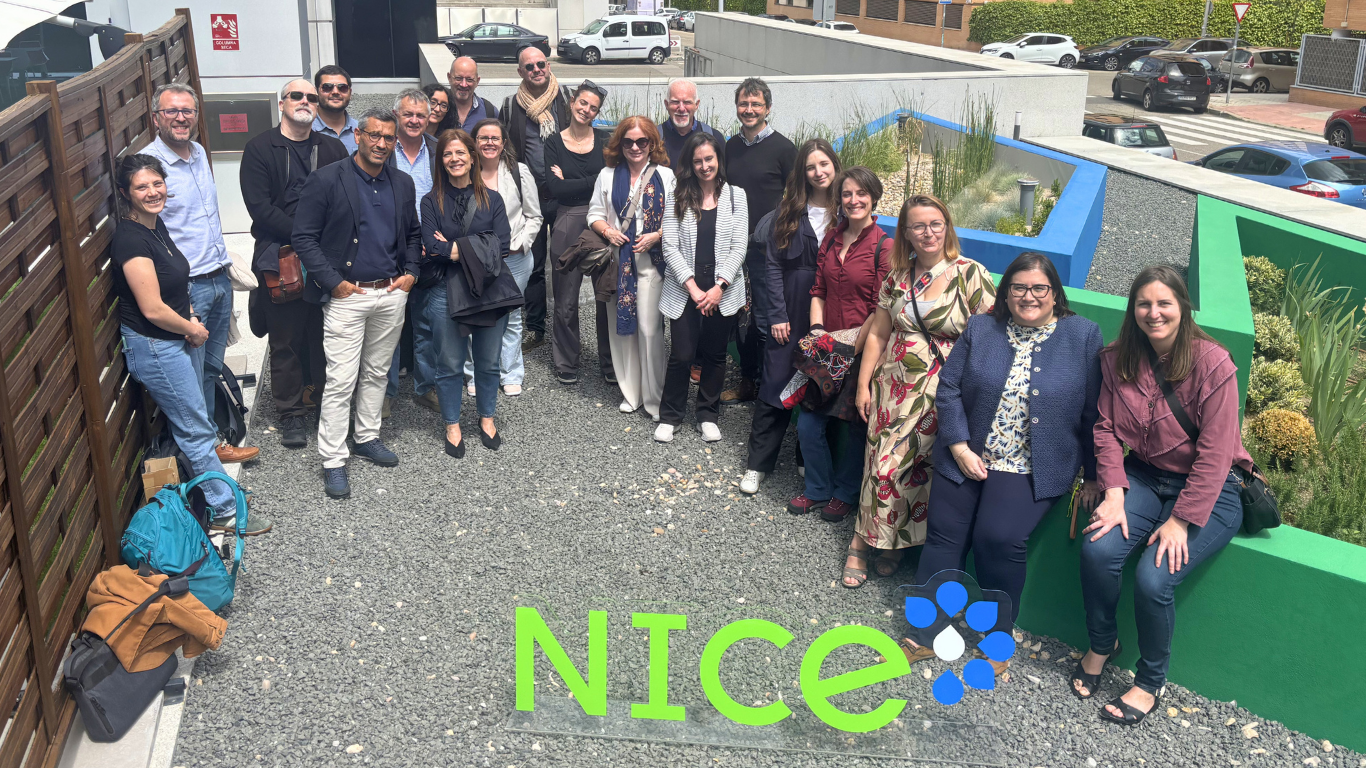
Representatives of the NICE consortium.
Extreme weather events, droughts, water pollution, increasing urban and agricultural demand… the water sector is facing growing environmental, technological, economic and social challenges. In response, Nature-based Solutions (NbS) have emerged as an innovative and sustainable approach to increasing both the availability and quality of water resources worldwide.
To help address some of the key challenges associated with urban water management, CETIM has coordinated the H2020 NICE project. Following five years of research, the project has now reached its conclusion, delivering significant advances in the optimisation and validation of innovative Nature-based Solutions. Today, we can confirm that NICE has contributed to improving circular water management, reducing pollution and promoting the safe reuse of water resources in several cities across the globe.
From laboratory research to full-scale demonstration
Working alongside an international consortium led by CETIM, NICE was structured in two main phases: an initial laboratory-scale research phase focused on technology optimisation, followed by a full-scale validation phase in which all innovations were implemented and assessed in different urban environments.
The solutions developed within project were first tested under laboratory conditions to optimise the physical, chemical and biological processes involved in water treatment. During this stage, CETIM identified adsorbent materials suitable for use as substrates in Nature-based Solutions, as well as microorganisms capable of removing more than 90% of emerging contaminants present in wastewater.
In collaboration with the consortium, we also optimised vertical gardens for greywater treatment, defined aeration strategies for constructed wetlands, and selected plant species with biocidal potential.
This work generated key knowledge regarding materials, vegetation, microorganisms, hydraulic configurations and optimal operating conditions. The resulting knowledge was subsequently transferred, adapted and validated through the implementation of more than 15 pilot systems across 13 cities in Europe and other regions worldwide.
In Spain alone, several technologies were validated at four different locations:
- Benalmádena (Costa del Sol): vertical gardens were installed for greywater treatment.
- Talavera de la Reina (Toledo): several innovative vertical wetland configurations were developed to significantly reduce organic matter, suspended solids, nutrients, pathogens and emerging contaminants, including pharmaceutical compounds, from urban wastewater.
- Madrid and Algeciras (Cádiz): hybrid wetlands were tested for the treatment of greywater and urban runoff, producing water suitable for specific reuse applications.
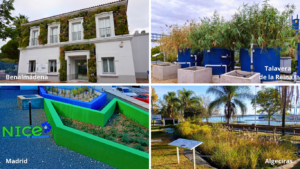
Pilot systems developed in Spain for NICE.
These pilot systems have demonstrated that combining different Nature-based Solutions, such as wetlands, rain gardens and vertical gardens, enhances overall water treatment performance while increasing resilience to variable operating conditions. Several of the systems developed achieved removal efficiencies exceeding 99% for indicator microorganisms, alongside significant reductions in organic matter, suspended solids and nutrients, as well as substantial improvements in the removal of heavy metals and emerging contaminants, depending on the technological configuration implemented.
In addition, CETIM carried out a comprehensive Life Cycle Assessment (LCA), Life Cycle Costing (LCC) and Social Life Cycle Assessment (S-LCA) to evaluate the overall impact of these technologies, their suitability for water treatment and reuse, and their potential for future implementation and replication across different urban environments.
The successful results achieved were presented at the project’s final event, held in Madrid last month, with the participation of the entire consortium. Coordinated by CETIM, the consortium included AQUALIA, ICLEI European Secretariat, Gdańsk University of Technology, Aarhus University, INRAE, EcoBIRD, Politecnico di Torino, IRIDRA, the Swedish University of Agricultural Sciences (SLU), LISODE, Gate2Growth ApS, Aguas y Aguas de Pereira and the Desert Research Centre.
Looking to the Future
Nature-based Solutions are not static technologies but dynamic systems that continue to evolve. NICE has clearly demonstrated that there is no single solution suitable for every context; rather, performance depends on factors such as the type of water being treated, climatic conditions, hydraulic design, the vegetation used and the filtration materials selected.
Consequently, numerous research opportunities remain open. These include optimising hybrid and multifunctional systems to adapt them to different climatic and urban contexts, or to provide multiple benefits simultaneously, such as thermal regulation, biodiversity enhancement and stormwater runoff reduction. Likewise, the study of next-generation emerging contaminants, including microplastics, microbiome engineering, functional vegetation and digitalisation, represents a range of promising research areas for advancing circular water management in urban environments.
At CETIM, we are already continuing this work through new initiatives such as LIFE smallWAT, where we are developing innovative solutions for water treatment and reuse. These efforts aim to promote more circular, sustainable and resilient water management models, while increasing acceptance, implementation and replicability across both urban and industrial settings.
Although challenges remain in improving water availability and treatment, NICE has firmly established Nature-based Solutions as an effective, resilient and sustainable pathway towards achieving circular water management in urban environments.
NICE received funding from the European Union’s Horizon 2020 Research and Innovation Programme under Grant Agreement No. 101003765.