


At CETIM we offer sustainable solutions through biotechnology to boost the circular economy in industry
Today is International Biotechnology Day, a discipline in which we work in our Technology Centre through 14 projects, mobilising more than 70 million euros and contributing to the sustainable development of the planet.
RECOBATs, a pioneering battery recycling initiative; FERTINSECT, for more efficient, safer and environmentally friendly bioactive fertilisers; and H2020 REWAISE, which will transform wastewater treatment plants.
International Biotechnology Day 2025.
As every 16th June since 1980, today is the International Biotechnology Day, a set of disciplines in which living organisms, such as microorganisms or enzymes, are used to obtain products through the application of genetic engineering. In the case of CETIM Technological Centre, the use of biotechnology goes back to our origins and has always been linked to industry, to the sustainable development of the planet and to environmental improvements. Proof of this are the 14 projects that we have underway in this field and which mobilise more than 70 million euros. Today we are going to get to know three of them: RECOBATs, FERTINSECT and H2020 REWAISE.
Second life for Lithium-ion batteries at the end of their useful life
With the increased use of electric vehicles and new technologies, the demand for raw materials on which Spain depends on other countries, such as lithium, cobalt and nickel, is increasing. These elements are indispensable in the manufacture of new batteries and electronic devices and, in order to avoid dependence on imports, since supply can be interrupted by different geopolitical factors, it is necessary to recover these elements and be able to reintroduce them back into the value chain.
Under this need arises the RECOBATs project, a research led by CETIM in which a comprehensive and versatile strategy is being developed to give a second life and recycle lithium-ion batteries at the end of their useful life. To this end, we are developing biohydrometallurgy and electrochemical technologies, which will make it possible to recover and purify strategic materials from the black mass of the batteries. In addition, we will carry out the selective separation of its components, such as anodes and cathodes, the synthesis of new cathodes, and the assembly of electrochemical cells.
In this way, electric vehicle batteries that are still in optimal condition can be adapted for reuse in devices such as scooters, electric bicycles or in renewable energy storage, while those that have to be withdrawn from the market will have their metals and high-value materials recovered to reincorporate them into the value chain.
RECOBATs has the involvement of entities such as ECOINTEGRAL, Apria Systems, BeeCYCLE, DGH, Envirobat, FCC Ámbito and Recyclia, which cover the entire battery recycling process; and a scientific consortium of experts in the field such as CETIM, AIMEN, Centro Ibérico de Investigación en Almacenamiento de Energía CIIAE and CSIC-CENIM.
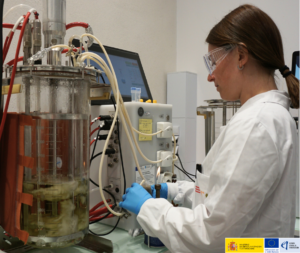
Bioleaching reactor in CETIM’s Bioprocesses laboratory.
RECOBATs: Development of an integrated battery recycling strategy (PLEC2024-011135) is funded by the Ministry of Science, Innovation and Universities and the State Research Agency (MCIU /AEI /10.13039/501100011033) and by the FEDER, EU, through the call for grants for R&D projects in strategic lines within the framework of the Transmissions 2024 initiative in cooperation with the group of companies receiving funding from the Centro para el Desarrollo Tecnológico Industrial (CDTI).
FERTINSECT: Biotechnological innovation for sustainable agriculture
The use of mineral fertilisers has increased crop productivity, but has also generated negative environmental impacts. It is estimated that 50% of the fertilisers applied are not absorbed by plants, leading to a waste of resources and contributing to problems such as the eutrophication of aquatic ecosystems.
That is why from CETIM and Galinsect, an insect farm located in Pontevedra and specialised in Tenebrio Molitor (commonly known as mealworm), we are looking for innovative biotechnological solutions that contribute to the development of more efficient and sustainable natural fertilisers in the FERTINSECT project. To this end, we are reusing by-products from the rearing of these insects that are rich in chitosan, a natural biopolymer derived from the chitin present in the exoskeleton of these insects, and which has multiple benefits in agricultural fertilisation, such as its antimicrobial and biodegradable properties.
Thanks to this research, waste generated in the agricultural sector will be minimised and dependence on non-renewable resources in the manufacture of conventional fertilisers, two of the challenges facing the agricultural sector, will be avoided.
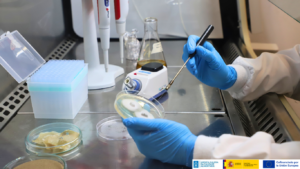
Mushroom culture carried out at CETIM for FERTINSECT.
FERTINSECT is subsidised by the Agencia Gallega de Calidad Alimentaria in the framework of the Grupos Operativos 2024 de la Asociación Europea de Innovación (AEI) (MR331B) and is co-financed by the Fondo Europeo Agrícola de Desarrollo Rural (FEADER) in the Plan estratégico de la política agraria común (PEPAC) 2023-2027.
Creating a circular water ecosystem in H2020 REWAISE
Natural resources are scarce and this, together with the effects of climate change, means that more and more areas throughout Europe are facing new and more severe limitations in terms of access to water and energy resources. Faced with this problem, at CETIM we are looking for solutions through our research and with the collaboration of companies and scientific entities from all over Europe.
An example of this is H2020 REWAISE, a project led by FCC Aqualia and involving 23 partners from 11 European countries, including our Technology Centre, to contribute our extensive experience in the biotechnological field and create a new intelligent water ecosystem based on the principle of circular economy and taking advantage of the resources present in water.
To this end, we are researching the production of biodegradable polymers from organic matter in wastewater through the action of certain microorganisms. This creates a new product with biodegradable and biocompatible properties with the potential to replace petroleum-based plastics, while reducing the economic costs of wastewater management in treatment plants.
In addition, at CETIM we are investigating for REWAISE the possibility of recovering lithium from brines, as it is a critical raw material essential for the manufacture of batteries.
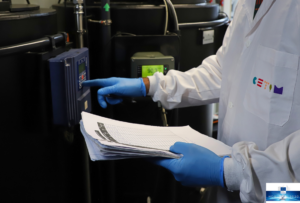
Pilot plant for obtaining polyhydroxyalkanoates (PHA) built at REWAISE.
REWAISE has received funding from the European Union’s Horizon 2020 research and innovation programme under grant agreement no. 869496.
The results obtained so far in these three research projects ensure that biotechnology is a fundamental tool for establishing circular economy models in industry and thus contributing to the sustainable development of the planet.