


CETIM lead RESURGENCE to find solutions for sustainable water use in industry
In the project, which is funded by Horizon Europe and involves 20 partners from 11 countries, we will search innovative solutions for industrial water management through the development of novel technologies that also recover water, energy and high-value raw materials in the process.
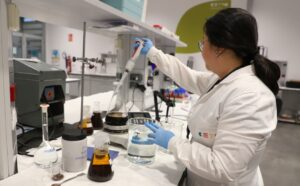
Laboratory tests for RESURGENCE.
The beginning of summer brings with it a big challenge: water scarcity. More and more areas of Spain and Europe are subject to high water stress, a situation that is aggravated by the high temperatures typical of the summer season and the lack of rainfall. This situation can pose a threat to the continuity of industrial production, especially for companies that need water to manufacture their final products, such as the chemical and paper sectors.
Therefore, it is necessary to develop methodologies and technologies that allow the reuse of this water, as is the case of the project that we are leading at CETIM, RESURGENCE HEU. With the collaboration of 20 partners from 11 countries and financed by Horizon Europe, the initiative will search innovative solutions for the circular management of water and will apply digital tools, such as physical and software sensors for data acquisition, improving energy efficiency and resolving possible risks that may arise in the process.
For this, RESURGENCE focuses on four case studies spread across Portugal, Turkey, Poland and Spain, covering the pulp and paper, chemical and steel sectors and exploring synergies between urban water treatment and industrial operations.
CETIM Expertise
From CETIM we will coordinate RESURGENCE during its four years of execution and, therefore, at the beginning of this year, we held the first meeting at our facilities in Culleredo (A Coruña) with the participation of the entire consortium: Water Europe, The Navigator Company, Organik Kimya, CELSA GROUP, Aqualia, University of Porto, KTH Royal Institute of Technology, National University of Sciences and Technology (NUST), FER, Scuola Superiore Sant’Anna, University Nova of Lisboa, Funditec, Aquaporin A/S, Pozzi Leopoldo srl, ENCO Engineering and Consulting srl, Strane Innovation, 20FIFTY PARTNERS, BARNA STEEL SA and RAIZ INSTITUTO DE INVEST DA FLORESTA E PAPEL. At the meeting, we established the first steps that we will take in the project to achieve the objectives set, which are the following:

RESURGENCE consortium meeting in Culleredo (A Coruña).
- Improve monitoring, circularity and management of water and energy in industrial wastewater.
- Achieve energy recovery (heat, biogas, electricity) and generation from industrial wastewater treatment processes.
- Increasing industrial sustainability through solutions that enable resource circularity and climate neutrality.
- Engage stakeholders and communities to achieve positive impact.
In addition, our Technological Centre we are already working on the initiative to create a new model of circular water management in industry, aimed at zero waste and zero emissions, thus achieving climate neutrality. We will do this through the development of the following technologies:
- Water reuse technologies, such as membranes and selective adsorption among others, with which we can recover water and reuse it, avoiding the discharge of wastewater and the depletion of water resources, such as rivers.
- Water treatment technologies, such as electrochemical technologies, which allow for the recovery of high-value raw materials and the reuse of resources.
- Energy recovery technologies through biogas and hydrogen as well as heat exchange.
Impact
This is how RESURGENCE will increase the efficiency of the entire industrial water management process, driving the transformation of European industries to become circular and climate neutral by 2050.
Thanks to this clear commitment to research, innovation, and collaboration, the project will significantly contribute to climate neutrality, circularity, and competitiveness of the European Union industry. This overcoming current and future challenges in the water sector and ensuring a more sustainable future for all.