


CETIM manages to recover complex plastic waste of high value for the automotive sector
In ECLIPSE, we have researched and developed advanced technologies that not only improve the current recycling processes of waste derived from End-of-Life Vehicles and currents in the automotive sector, but also allow the use of secondary raw materials from these complex polymeric wastes, thus reducing the pollution generated by discharges.
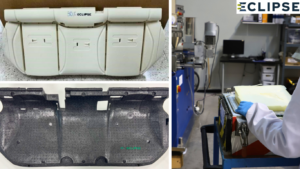
On the left, rear seat and rear seat enhancement developed at ECLIPSE and on the right, foam testing with recycled materials at CETIM’s pilot plant.
Plastic pollution continues to grow by leaps and bounds, with most of the plastics we consume ending up in landfills, incinerated or deposited in the environment. Only 9% of the plastic waste generated worldwide is successfully recycled, according to the ‘Global Plastics Outlook’ report by the Organisation for Economic Co-operation and Development (OECD). This low recycling rate is largely due to the presence of complex plastic materials such as multilayers, polymer mixtures with reinforcements and heavy metals, as well as the limitations of current sorting and separation technologies and the chemical incompatibilities of polymers with recycling processes.
For this reason, from CETIM and together with TÉCNICAS REUNIDAS, we have carried out the scientific coordination of ECLIPSE, a project funded by the Center for Technological Development and Innovation (CDTI) within the Misiones 2021 call, in which we have researched and developed advanced technologies that not only improve the current recycling processes of waste derived from End-of-Life Vehicles (VFUs) and currents in the automotive sector, but also allow the use of secondary raw materials from these complex polymeric wastes.
New technological routes for recycling and recovery of plastic waste
The aim of the ECLIPSE project has been to investigate new technological routes that facilitate the recycling and recovery of complex polymeric waste (plastics) and that represent a significant advance with respect to the current state of the technique in terms of separation, recycling, purification, chemical synthesis and formulation to obtain new polymeric materials suitable for new use.
To achieve this, mechanical, thermochemical, chemical, biotechnological technologies and synergistic combinations between them have been developed. This has made it possible to successfully solve the limitations presented by conventional mechanical recycling, such as the need to use high-purity plastic waste or the impossibility of using certain thermoset materials.
At the same time, in addition to the research study of recycling technologies, complementary solutions to current processes have also been studied, to achieve the circularity of the global process and guarantee the drastic reduction in the generation of waste that goes to landfill: identification and separation stages (high purity in waste streams obtained), purification and isolation of chemical units of interest, Synthesis of chemical specialties and advanced formulation.
To achieve these advances, ECLIPSE has had the synergic collaboration of eight business partners: TÉCNICAS REUNIDAS (leader of the consortium), SEAT, PICVISA, ACTECO, CELLMAT TECHNOLOGIES, SYNTHESIA TECHNOLOGY, REPSOL and GRUPO COPO; and eight research organizations: CETIM (scientific coordinator), Polytechnic University of Valencia, University of Zaragoza, LEITAT, University of Valladolid, Chemical Institute of Sarriá, CTAG and the National Supercomputing Center in Spain.
Each of the companies has worked on the different phases of the process: diagnostic analysis, separation, recycling, purification and isolation, synthesis of chemical specialties, formulation of thermoplastic and thermoset materials, eco-design and manufacture of automotive parts/prototypes.
CETIM’s expertise
At CETIM we have applied the knowledge of our three Knowledge Areas:
At Advanced Materials, we carry out, in collaboration with the consortium, the analysis of complex plastic waste derived from VFUs, the recycling of polypropylene (PP) streams through chemical processes, the development of PP chemical specialties and the study and improvement of the eco-design of key processes and components in the automotive sector.
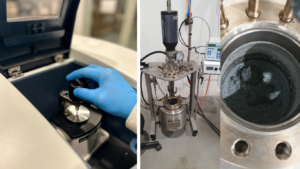
On the left, analysis of plastic waste by FTIR, on the right, chemical recycling carried out at CETIM.
At Digital Industry we have developed photonic technologies for the identification and classification of polymer waste.
At ECO BIO Technologies we have contributed to the recycling of polypropylene (PP) and polyethylene (PE) through pyrolysis and PP, PE and polyurethane (PU) through biological processes. In addition, the Technological Centre has carried out proofs of concept and technical, economic and environmental analysis of the technologies and products finally proposed, which show that thanks to ECLIPSE the levels of recovery and recovery of complex plastic waste will be increased by up to 80%, reducing the carbon footprint by 75%.
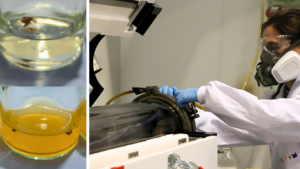
On the left, biological recycling and on the right, thermal recycling, both carried out at CETIM.
Sustainable, circular, versatile system applicable to other sectors
The ECLIPSE consortium has successfully completed the project, obtaining a sustainable, circular and comprehensive system for recycling and recovery of complex plastic waste. This system, versatile and proven in the automotive sector, has a high potential for transfer to other strategic industrial sectors.
Highlights include the development of key technologies for the separation, recycling and recovery of complex plastic waste, in particular PP, PE and PU-based waste, thus opening up new possibilities for the circular economy.
In addition, the development and manufacture of five prototype parts for the automotive industry (the front and rear seat, the rear seat enhancement, the pedal heel cup and standardized specimens for the validation of the rear bumper slat) has been achieved, demonstrating the feasibility of integrating recycled materials in automotive components.
Among the main milestones achieved in the project, the following stand out:
- 94.28% of recoverable material has been recovered, which highlights the efficiency of the recycling process.
- The manufactured parts have managed to incorporate between 25 and 30% recycled material, depending on the piece.
- The carbon footprint has been significantly reduced, reaching only 0.466 kg of CO2 equivalent per kilogram of input waste, compared to the 0.640 kg CO2 equivalent generated in incineration processes, highlighting the positive impact of the project in terms of sustainability and emission reduction.